
Matt Swift leads AI and Automation at Headstar, working alongside the firm’s finance leadership team to identify practical opportunities to save time, improve reporting and reduce manual administration.
Over the last year, Matt has identified and introduced a range of AI and automation solutions across the business, including improvements to forecasting, management reporting, dashboards and credit control processes. Collectively, those changes are now saving more than 95 hours every month across the business.
Ahead of Headstar’s upcoming AI in Finance webinar,, Matt shares what he’s learned from conversations with CFOs, Finance Directors and Financial Controllers about where AI can genuinely add value – and where it probably won’t.
What Finance Leaders Are Really Saying About AI
Over the last few weeks, I’ve been asking CFOs, Finance Directors and Financial Controllers a simple question: Are you using AI in your finance team yet?
The answers have been interesting.
Most finance leaders I speak to are not against AI. Far from it.
A lot are using ChatGPT, Claude or Copilot in some form. Some are using it for reports, meeting notes, research, admin or first drafts of documents. Some are looking at invoice processing or automation. Some are improving their systems and data first because they know AI will only be useful if the foundations are right.
But very few are using AI in a joined-up way across finance.
That’s not because they lack interest.
It is usually because they are busy, under-resourced and do not have hours spare to play around with different tools until something works.
And that is the bit I think gets missed.
Finance teams do not need more vague AI ideas. They need practical use cases that save time, reduce manual work or improve the quality of information they already rely on.
The question should not be: “Where can we use AI?”
It should be: “Where is the finance team losing time every week?”
That’s usually a much better starting point.
Too often, AI conversations begin with the technology.
In my experience, the most successful projects start with the finance process instead. Identify the task that consumes time, creates frustration or adds little value, then explore whether AI, automation or a simple process improvement could help.
Where AI can actually help finance teams
Here are four areas I think finance leaders should be looking at.
1. Turning messy finance data into something usable
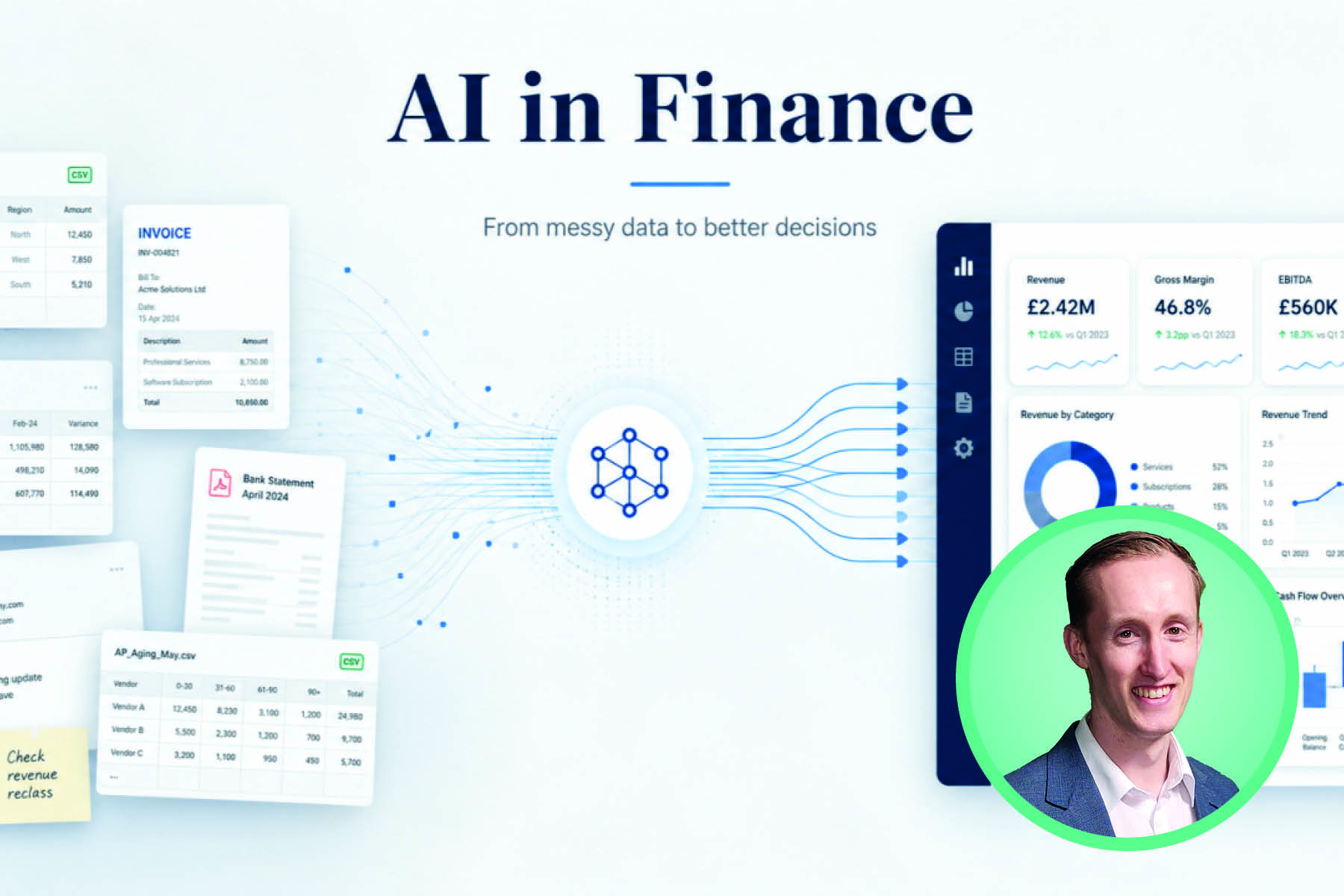
A lot of finance teams are sitting on useful data, but it is spread across spreadsheets, systems, exports, emails and reports. The information is there, but it takes too long to pull together. AI can help make that data more usable.
For example:
- Summarising supplier spend by category
- Reviewing customer spend patterns
- Pulling out trends from exports
- Highlighting gaps or inconsistencies
- Turning raw data into a cleaner first version for review
- Helping finance ask better questions of the data
This does not replace proper reporting or good finance judgement.
But it can reduce the time spent cleaning, sorting and making sense of information before the actual analysis starts.
The value here is not “AI gives you the answer”. The value is getting to the useful part faster.
2. Credit control prioritisation
Credit control is an area where people often jump straight to full automation.
That might work for some businesses, but not all.
If you have low transaction volumes, difficult customer relationships or invoices that need proper human judgement, a full automation tool may not be worth the cost.
But that does not mean AI has no use.
A more practical starting point could be helping the credit control team prioritise their work.
For example:
- Which customers need chasing first?
- Which overdue balances have changed the most?
- Which accounts have a different payment pattern than usual?
- Which customers need a softer or firmer message?
- What should today’s chase list look like?
- Can we draft tailored chase emails based on the account history?
That is very different to handing the whole process to AI.
It is using AI to support the person doing the work, not replace their judgement.
For smaller finance teams, that distinction matters.
3. Process documentation, controls and handovers
This is probably one of the most underrated uses.
A lot of finance processes live in someone’s head.
That is fine until they leave, go on holiday, move roles, or the business needs to scale.
Most finance leaders know they should document processes properly, but it rarely makes it to the top of the list.
AI can help speed this up.
You can take rough notes, checklists, emails, screenshots, Teams messages or process recordings and turn them into:
- Process notes
- Handover guides
- Control checklists
- Training documents
- Month-end task lists
- New starter guides
Again, it will not be perfect first time.
But it gives you a strong first version to review, rather than starting from a blank page.
This is not the flashiest AI use case, but it solves a real finance problem.
It reduces key-person risk. And for a busy finance team, that has real value.
4. Improving spreadsheet-based workflows
Spreadsheets are not going anywhere.
And I do not think finance teams should be told to “just get rid of spreadsheets”. They are flexible, familiar and often do the job.
But a lot of spreadsheet-based processes could be improved.
In our own team, we recently improved a spreadsheet-based workflow that had been used in a similar format for years. The aim was not to rip everything out and start again.
It was to keep the useful parts of the process, but make the data cleaner, easier to report on and more valuable. That meant we could get better visibility on things like numbers, costs, client spend and performance.
The result was a process that required less manual intervention, produced more useful management information and gave finance leaders better visibility of performance.
The key point
AI and automation do not always need to replace what is already working.
Sometimes the best use is improving the workflow around it, so the information being captured is more accurate and more useful.
Most finance teams will have at least one process like that, such as:
- A spreadsheet that works, but is clunky.
- A report that gets produced, but takes too long.
- A tracker that is useful, but hard to analyse.
That is often where the opportunity sits.
Before introducing AI
AI works best when there is some structure.
Before looking at tools, I would ask:
- Is the process repeated often enough to be worth improving?
- Is the data reasonably clean?
- Is there a clear output?
- Does someone own the process?
- Would saving time here actually make a difference?
- Is the current process documented clearly enough for someone else to understand?
If the answer is no to all of those, AI probably will not fix it.
It may just add another layer of confusion.
If the process is unclear to the team, it will usually be unclear to AI.
What AI will not fix
This is where I think finance leaders are right to be cautious. AI will not magically fix poor supplier data.
It will not make inconsistent invoices suddenly easy to process.
It will not justify expensive software if the transaction volume is too low.
It will not replace commercial judgement.
And it will not help much if nobody has properly mapped the process in the first place.
That does not mean it is not useful.
It just means the starting point matters.
For most finance teams, the best starting point is not a huge AI project.
It is finding one repeatable finance problem that costs time every week, then asking whether better structure, cleaner data or light automation could improve it.
That might be credit control. It might be process documentation. It might be cleaning up reporting workflows. It might be turning messy data into something the team can actually use.
The finance leaders I speak to are not asking whether AI will matter.
They are trying to work out where it genuinely saves time, and where it creates more value.
That is the conversation worth having.
The organisations seeing the greatest value from AI are not necessarily those spending the most money on technology.
They’re often the ones that understand their processes, know where time is being lost, and take a practical approach to solving those problems.
In many cases, that doesn’t require a major software investment. It simply requires a clearer understanding of where AI and automation can make the biggest difference.
Interested in seeing AI in Action Within a Finance Function?
If you’d like to see a practical example of AI in action within a finance function, join Matt for our upcoming free webinar: Build a Better Cashflow Forecast in 15 Minutes Using AI
During this live session on Wednesday 16th September, 12.30pm – 1.30pm on Zoom, Matt will demonstrate how AI can be used to build a better cashflow forecast in just 15 minutes using Claude AI. You’ll also learn practical copy-and-paste prompts, understand how to use AI securely, and discover where AI and automation can genuinely save time within a finance team.
Attendees will also have the opportunity to apply for one of a limited number of complimentary AI in Finance Consultations, normally worth £250.
Click here to register your free place: https://zoom.us/webinar/register/WN_7EJlABPfQK21hqIn2m2OJg
About the Author
Matt Swift is Headstar’s AI and Automation Specialist and works exclusively within the finance profession as a recruiter.
Alongside Headstar’s finance leadership team, Matt has helped implement AI and automation solutions that are currently saving more than 120 hours every month across the business. His work has included improving forecasting processes, enhancing management reporting, automating credit control activities and creating dashboards that provide greater financial insight with less manual effort.
Matt regularly works with tools including Claude, ChatGPT Enterprise, Microsoft Copilot, n8n, Zapier and Microsoft Excel, and has completed the Claude Code in Action certification.
Most importantly, his approach is grounded in real-world experience. The solutions and techniques he shares have been tested and implemented within a real business environment alongside qualified Finance Directors.
